AI in Non-Fiction
Dive into factual books about AI theory, history, ethics, and real-world applications.
A World Without Work
In “A World Without Work,” Derek Thompson explores how automation and artificial intelligence could fundamentally change — and potentially eliminate — many forms of human labor. He argues that as machines grow increasingly capable, society may face widespread technological unemployment, not just in factories but in white-collar and creative jobs as well.
.jpg)
Supremacy: AI, ChatGPT, and the Race that Will Change the World
In Supremacy, Olson, tech writer at Bloomberg, tells the astonishing story of the battle between the world’s two leading AI firms, OpenAI and DeepMind, their struggles to use their tech for good, and the hazardous direction they could go as they serve two tech Goliaths whose power is unprecedented in history. The story focuses on the continuing rivalry of two key CEOs at the center of it all, who cultivated a religion around their mission to build god-like super intelligent machines: Sam Altman, CEO of OpenAI, and Demis Hassabis, the CEO of DeepMind.
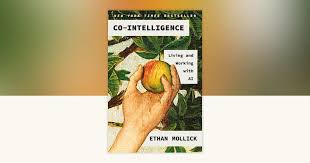
Co-Intelligence: Living and Working with AI
Mollick argues that AI should be viewed not as a replacement, but as a co-intelligence—a partner in creative, cognitive, and collaborative work, amplifying human capabilities rather than simply automating them. He introduces four guiding principles for working with AI: 1) invite AI to the table, 2) be the human in the loop, 3) treat AI like a person (but define its role), 4) assume the AI you’re using is the worst you’ll ever have (so you stay adaptive).
.jpg)
Human Compatible: Artificial Intelligence and the Problem of Control
In the popular imagination, superhuman artificial intelligence is an approaching tidal wave that threatens not just jobs and human relationships, but civilization itself. Conflict between humans and machines is seen as inevitable and its outcome all too predictable. In this groundbreaking book, distinguished AI researcher Stuart Russell argues that this scenario can be avoided, but only if we rethink AI from the ground up. He suggests that we can rebuild AI on a new foundation, according to which machines are designed to be inherently uncertain about the human preferences they are required to satisfy. Such machines would be humble, altruistic, and committed to pursue our objectives, not theirs. This new foundation would allow us to create machines that are provably deferential and provably beneficial.
The Coming Wave: Technology, Power, and the Twenty-first Century's Greatest Dilemma
.jpg)
Genesis: Artificial Intelligence, Hope, and the Human Spirit
a 2024 non-fiction New York Times best seller book from the late diplomat and political scientist Henry A. Kissinger, the American businessman and former computer engineer Eric Schmidt and the American businessman Craig Mundie. The authors illuminate the ethical and social questions associated with the development of AI and provide perspectives on how we can shape these technologies responsibly.
Tools and Weapons: The Promise and the Peril of the Digital Age
.jpg)
The Alignment Problem: Machine Learning and Human Values
Superintelligence: Paths, Dangers, Strategies

Life 3.0: Being Human in the Age of Artificial Intelligence
a 2017 non-fiction book by Swedish-American cosmologist Max Tegmark. Life 3.0 discusses artificial intelligence (AI) and its impact on the future of life on Earth and beyond. The book discusses a variety of societal implications, what can be done to maximize the chances of a positive outcome, and potential futures for humanity, technology and combinations thereof.